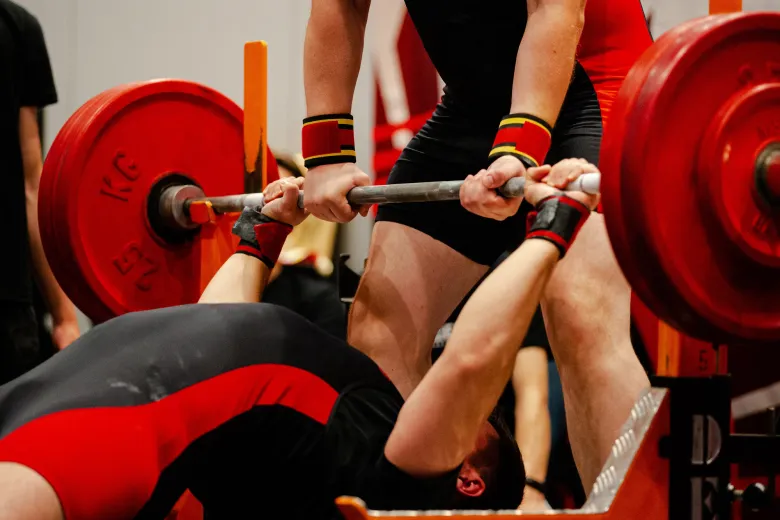
The sport of powerlifting is simple- the person who lifts the most combined poundage in the Squat, Bench Press, and Deadlift wins the contest. For this reason, the Squat, Bench Press, and Deadlift should be the core of a powerlifter’s training routine.
Training for power lifters should consist of hard, brief, and infrequent workouts using these three exercises as the focal point of a training routine.
One should not attempt to implement the same training routine for competitive powerlifters as they would for football players, basketball players, and other athletes. The sport of power lifting is lifting weights. And, athletes in other sports need not be focused on the elements of competitive powerlifting. However, all athletes can learn something from the basics of powerlifting.

Off-Season Powerlifting Off-season training should focus on increasing muscle strength and endurance by performing relatively high repetitions (8-20). In fact, a powerlifter’s off-season strength training does not need to differ from that of other athletes.
Athletes in other sports can use the Squat, Bench Press, and Deadlift for strength training– but for powerlifters, these are the specific skills of the sport that need to be mastered.
Sets Many powerlifters don’t believe that one or two work sets of Squats, Bench Presses, or Deadlifts are all that is needed to get stronger. The quality of a set is more important than the quantity of sets.
If your intensity is high, you don’t need to do more than one or two sets per exercise. In fact, if your intensity is truly high, you literally will not be able to do more than one or two sets. You can work out hard, but not long and hard. Hard and long are mutually exclusive in strength training. They are mutually exclusive in powerlifting as well.
In addition to the competitive lifts, many powerlifters make the mistake of performing too many additional exercises and, therefore, too many additional sets. The additional exercises are commonly referred to as assistance exercises. This practice often results in over training. Keep in mind; the true purpose of assistance exercises is to build overall strength.
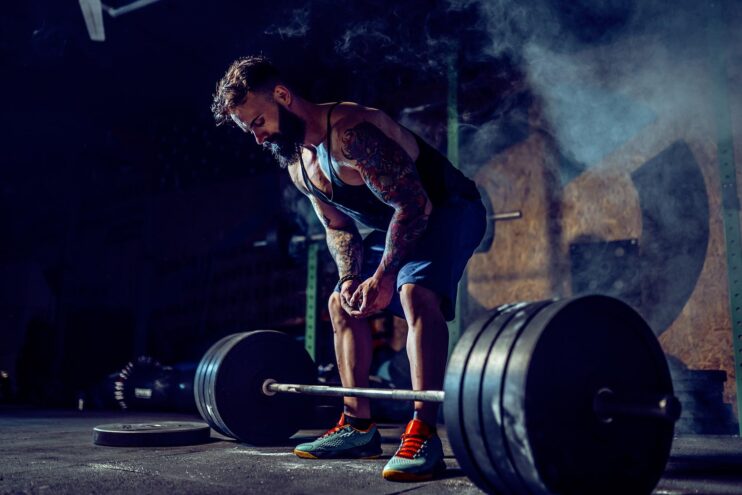
Repetitions During the off-season, a powerlifter does not need to use repetition ranges that are any different from athletes in any other sport. Based on a 6-second repetition (2-seconds up, and 4-seconds down), a general guideline would be to perform 10-20 repetitions for the lower-body exercises and 8-15 repetitions for the upper-body exercises.
Frequency Strength training is very stressful to the body. The body must be given and adequate amount of time to recover and to adapt to the stress and hence get stronger. A powerlifter should perform at least two of the three competitive lifts during a workout.
This will help to maximize recovery between workouts. A full-body workout can also be performed once a week to maximize recovery between workouts. For most powerlifters, two workouts per week are more than adequate. Contrary to popular belief, your muscles will not lose size and strength if more than 48 hours or even 96 hours elapses between workouts.

Pre-Contest Training Before a contest, powerlifters must practice the Squat, Bench Press, and Deadlift in the same manner as these lifts will be performed in the contest. This means that the number of repetitions must be decreased and the amount of weight must be increased.
However, there is no reason to reduce the number of repetitions during off-season training. Lifting heavy weights for low repetitions takes a toll on the body that should be avoided during off-season training.
As the number of repetitions decreases, the margin for error in technique decreases and the potential for injury increases. Unfortunately, many powerlifters use low repetition ranges- even during their off-season training- and this often results in injury, over training, and lack of progression.
Conclusion To excel in any sport, the specific skills of the sport must be practiced to perfection. In powerlifting, this means practicing the lifting of heavy weights for low repetitions in the Squat, Bench Press, and Deadlift.
Skill practice should not be confused with what is necessary to build muscle- hard, brief, and infrequent training. The tips provide the means to build the muscle and it’s the muscle that moves the weight on the powerlifting platform.