
The snatch is the first lift executed in weightlifting competitions. Less weight can be used than in the clean, as it must be pulled much higher. A wider grip is used to decrease the height somewhat, but there is still a significant difference.
Also, it is far more difficult to rise from the bottom of a snatch, as the bar is balanced overhead, instead of firmly racked on the shoulders. This requires much greater strength in the upper back, especially the rhomboids. The snatch can be executed with either a squat or a split style, but only the far more common squat style will be discussed.
Phase One

Set Up: Feet about shoulder-width apart, with the toes, turned slightly outward. The setup should be like the most powerful setup for a vertical leap. Shins should be almost touching the bar, and the bar should be over the metarso-phalangeal joint of the feet (where the toes join the foot). The knee angle should be between 65 and 90 degrees. Arch the back. Grip at least one and a half times shoulder width, and use a hook grip.
Make sure the arms are straight, flex the triceps if necessary, as pulling with bent arms can lead to elbow injuries and bicep tears. The shoulders should be either directly above or slightly in front of the bar. Look upward only slightly. The torso should be inclined between 25′ 60 degrees with respect to the platform. This phase begins when the athletes applies force to the barbell and it ends when at the instant of barbell separation from the floor (IBS).
The object of this phase is to create a rigid kinematic chain between the athlete and the barbell, referred to as the athlete-barbell system, and tension between the athlete and the floor, which will contribute to the acceleration of the barbell. At the conclusion of this phase, there should be no slack between the body and the barbell. By the numbers:
Note: Where there are three numbers separated by a slash, such as x/y/z, this would indicate difference for athletes 150/170/190cm tall.
First Phase: Knee angle at start of pull: 45′ 90 degrees Knee angle at end of phase: 80′ 110 degrees Arm angle with respect to bar: 49′ 63 degrees Torso inclined: 25′ 50 degrees.
Phase Two
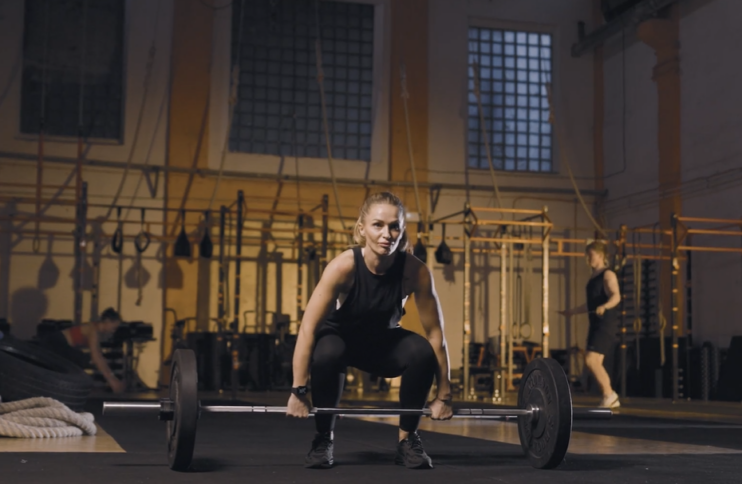
Preliminary Acceleration. Begin by straightening the legs, and the hips joints, which will move almost vertically during this phase, which will cause the torso to lean forward a little and the shoulders to move farther in front of the bar. Maintain the arch in your back at all times.
The head will move back to a vertical position. Smoothly pull the bar from the deck and begin to accelerate it. Do not jerk it from the platform. The bar will continue to accelerate even after the legs have been straightened. The barbell should move toward the athlete slightly, which will alter the combined center of gravity (CCOG).
The greater the distance between the COG of the body and the bar at the start, the greater the barbell shift during this phase of the pull. This phase will end when the legs have straightened, but the feet are still flat on the platform. The objective of phase two is to move the barbell upward and begin acceleration in preparation for phase three. The majority of the work in this phase is executed with the legs.
This phase generally begins when the knees have straightened to 110 degrees, and ends when the knees have reached an angle of 145 to 155 degrees. This phase is initiated by a contraction of the quadriceps, glutes, and erector spinae. The weight of the athlete will shift from just behind the ball of the foot toward the heel at the end of this phase, as the latissimus dorsai contract to pull the bar in toward the lifter.
Second Phase:
- Knee angle at start of pull: 80′ 110 degrees
- Knee angle at end of phase: 145′ 150 degrees
- Torso inclined: 30 degrees
- Hip angle: 85′ 90 degrees
- Average time elapsed at end of second phase: .4′ 0.55 seconds Bar speed at end of second phase: 1.3/1.45/1.6 m/sec. Barbell shift toward athlete: 3/6.5/10 cm Barbell height at end of second phase: 46.5/52.7/58.9 cm
Phase Three

Rebend: Often called the adjustment or the amortization phase. This phase is used to position the athlete-barbell system (ABS) for the final explosion of the pull. Continue to straighten the torso, which should cause the hips to move forward, and rebend the knees slightly, this should occur when the bar is about 1/3 of the way up the thigh (past the knee joint).
The rebending of the knees should end when the knees reach an angle of 125′ 135 degrees. This allows the athlete to move closer to the bar, with a resultant decrease in the resistance of the movement, and a more favorable CCOG.
Third Phase:
- Knee angle at start of phase: 150-155 degrees
- Knee angle at end of phase: 120′ 125 degrees
- Shins inclined toward the platform: 70′ 75 degrees
- Torso inclined: 58 degrees
- Hip angle: 105′ 110 degrees
- Elapsed time of third phase: 0.125 seconds
- Average distance of shoulders in front of bar: 6/6.8/7.6 cm Barbell speed at end of third phase: 1.22/1.37/1.52 m/sec Barbell shift toward athlete: 4/8/12 cm Barbell height at end of third phase: 52.5/59.5/66.5 cm
Phase Four
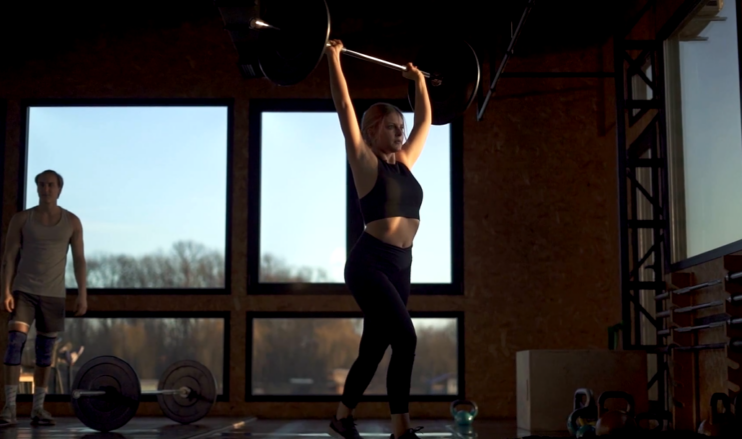
Final Acceleration: This is when the explosion should take place. (the shoulder girdle, bar, and metarso-phalangeal joints should all be in the same horizontal plane). Jump, violently straightening the legs and torso, rising onto the toes and shrugging as hard and quickly as possible. The elbows should remain extended and pointing outward during the shrugging movement. The barbell will move away from the lifter during this phase, describing a slightly forward arc, until it is moving nearly vertically.
The body should be slightly hyper extended at the completion of this phase, which will compensate for the forward shifting of the barbell, allowing the CCOG to remain over the support (the toes). The purpose of this phase is to impart as much force as possible, to achieve as great a height as possible. The bar should continue to rise on its own as the lifter begins the next phase. At the initiation of this phase, the erectors, glutes, and hamstrings are the major agonists.
The erectors will work not only to maintain a rigid spine, but to begin the acceleration of the barbell as the torso moves rapidly erect. The glutes and hamstrings contract in conjunction with the erectors to extend the hip joint. As the athlete jumps, the quadriceps contract strongly, and the trapezius is used to supply additional force at the top of the pull.
Fourth Phase:
- Knee angle at start of phase: 120′ 125 degrees
- Knee angle at end of phase: 175′ 180 degrees
- Torso inclined: 0′ 10 degrees away from platform
- Shins inclined: 0 degrees
- Hip angle: 180 + degrees (hyperextension)
- Elapsed time of fourth phase: 0.2 seconds
- Barbell speed at end of fourth phase: 1.65-1.8/1.78-1.93/1.9-2.05 m/sec Barbell shift away from athlete: 2/3/4 cm Barbell height at end of fourth phase: 97.5/110.5/123.5 cm
Phase Five

Unsupported Squat Under: Pull on the bar slightly as it is rising to help pull towards the athlete, while squatting down as quickly as possible. In theory, the athlete is trying to exert some sort of force on the bar at all times, and maintain control. The first portion of this is where the feet remain on the platform while the knees and hips begin to bend. As the bar passes the head, the elbows move down under the bar and the wrists turn over.
Fifth Phase:
- Feet remain on floor during squat under: 0.1′ 0.15 seconds
- Elapsed time during non-support phase: 0.15′ 0.33 seconds
- Elapsed total time of fifth phase: 0.25 – 0.48 seconds
- Barbell height at end of phase: 110.25/124.95/139.65 cm
Phase Six

Supported Squat Under: The feet are then thrust from the platform. During this phase, it is possible to raise the bar another 2.5 cm through the use of the arms while pulling under the bar. As in the clean, the heels are under the hip joints and the toes are turned to the side. The lower back is arched and the torso is tilted forward, more than in the clean.
The shoulder blades are flat and the arms are straight, while the head is tilted forward. During this portion of the lift, the bar will move backward, then down. Typically 5′ 9% of an athlete’s height. An experienced lifter can achieve a deeper squat position, thereby reducing the minimum height required to pull the bar.
Sixth Phase:
- Elapsed time of sixth phase: 0.3′ 0.6 seconds
- Barbell height at end of phase: 99/112.2/125.4 cm
When receiving the snatch, the bar is in line with the hips at the bottom. This means that it will be behind the head, which takes some time to adjust to. To minimize stress on both the shoulders and the elbows, the elbows should be rotated forward/outward as much as possible.
The arms must be absolutely rigid. When rising from the bottom of a snatch, first the hips will travel back while the shoulders move forward, although only slightly. To maintain tension in not only the arms while rising, but the upper back as well, concentrate on trying to pull the bar apart with the hands.
Some coaches advocate driving up out of the bottom as quickly as possible after stopping the bar’s downward progress’ even before the lifter is completely balanced. This may allow the lifter to be able to save a lift from a partially recovered position that would not be possible from a deep squat position.
Also, the application of force to the bar applies a certain amount of control that may save a lift that would otherwise travel outside the lifter’s base of support.
The ascent: After control is achieved, the legs begin to straighten secondary to the contraction of the glutes and hamstrings. The bar must remain in line over the hips to avoid tilting forward and losing the lift. At the top of the lift, the feet should be brought somewhat closer together.
Correcting simple mistakes in the snatch
The most common problem in the snatch is receiving, or catching the bar. If the athlete finds that the bar is drifting forward, lower the hips, raise the head, and immediately drive up from the squat. Lowering the hips brings them, as well as the lifters COG with respect to the bar, forward, positioning the athlete under the bar. When the bar has been over pulled and is drifting backward, the athlete should lower the head and torso, and raise the hips backwards. This shifts the lifters COG to the rear, once again in line with the bar.
Bending the elbows on the pull. This is an exceptional way to tear a bicep. To avoid this, flex the triceps during the first phase, and keep them flexed until the shrug during the fourth phase. There is a reason that the old adage “where the arm bends, the power ends” is still around. That reason is the simple fact that it is true.
Functional mechanics of the snatch
Maximum velocity of the barbell is a critical factor when determining training load. The product of maximum velocity (Vmax) and weight(m*g) presents the external (measured on the barbell) physical power component for the vertical barbell lift. This parameter is called speed-strength power.
(Ps-s): m x g x Vmax = Ps-s (Kg x m/(s)2 x m/s = W Note: (s)2 = speed squared
The total power contains a component for barbell acceleration as well. The value of this component is relatively low compared to the lift component. Because power is the work (energy) performed in a given time period, the relationship between the work required to accelerate and to lift the barbell express the relationship between the power components: Kinetic Energy: m/2 x (Vmax)2 Potential Energy: m x g x h
Where m = barbell mass; Vmax = maximum barbell velocity; g = 9.81 m/(s)2; h = path of vertical barbell lift.
The lift component of the work is roughly six times greater than the acceleration component. The relationship between the power components are comparable to the work relationship.
The goal of training should be to create higher power values. This can be done through the use of high pulls, wherein the lack of the need to receive the bar can allow for not only a greater training load, but more focus on increasing velocity. Once the maximum velocity of the barbell is achieved and there is no further accelerating force, the remaining path of the weight, which is the distance s, will be determined by the following equation: s = (v)2max/2g
It is worth noting that receiving the bar is not simply a matter of catching it, as the barbell can descend by a velocity of about 2.5 m/s when simply falling .32m. The goal should be to turn over as quickly as possible, and thus reduce the velocity of the descending barbell.

Force generation by various joints
In the snatch, the greatest power requirements fall upon the hip extensors, which play a vital role in the entire kinetic chain. A weakness in the hips will overload the knee joint, causing either a starting movement which is too fast as well as a decrease in velocity between the 1st and 2nd pulls.
A smooth transition is necessary to prevent overloading of single muscles, tendons, and joint structures. Hip power reaches its maximum value at the end of the transition phase. In descending order, the greatest power demands after the hips are met by the shoulder, knee, and ankle joints.
Bar path
While the bar will never be pulled in a truly straight line, the closer the athlete comes to achieve this, the higher the power generated. As a general rule, athletes with higher peak vertical power and peak vertical force tend to pull in a straighter line. Also, as the weight lifted relative to body mass increases, the power output will also increase. It is worth noting that the heavier the weight lifted relative to body mass the less horizontal displacement of the bar.
Alterations of bar path to effect a superior lift
A general backward displacement of the bar is related to successfully catching the bar. This assumes that the feet are displaced as well. By moving the bar backward and altering the CCOG by shifting the position of the lifter, the athlete is able to continue to direct the force on the bar up and rearward for as long as possible.
This is achieved by shifting the weight towards the heels at the initiation of the pull and finishing the 2nd pull with the hips over or behind the ankles. As the body leans back while the knee and hips fully extend, the shoulders shrug and calves flex to complete the pull. Moving the trunk upward during final hip extension enhances the ability to use body mass to project the bar upward.
Problems in bar trajectory and how to correct them
If the weight shifts forward over the toes at the start of the lift, the bar will be moving away from the base of support. The lifter must bring the bar toward the shin during the first pull and move the body backward, shifting the weight toward the heels.
If the bar drifts forward during the 1st pull, the athlete must avoid rising up on the balls of the feet too early, which will cause premature extension of the hips, and excessive swing of the bar away from the athlete during the fourth phase. If this occurs, the lifter must slide significantly forward during the unsupported squat under, or the bar will be dropped in front of the lifter when receiving.
Assistance work for the snatch
Power Snatch
This is quite simply a snatch executed without squatting under to receive it. When catching the bar, the lifter descends into no more than a quarter-squat. This will develop pulling power for the snatch as well as allowing the lifter to practice receiving the bar. There is less stress on the hips during this exercise compared to the classic snatch, but there can be more stress on the knees, if the weights are great. In some cases, the power generated during this lift can be greater than in the snatch.
Hang Snatch
This is a snatch performed with the bar starting at a higher level that the platform. Such levels commonly include below the knee, above the knee, and from a dead hang. This lift can be performed in a manner similar to either the snatch or the power snatch, for extra emphasis on pulling power.
Overhead Squats
After power snatching the bar into place, the lifter will descend into a full squat position. Care must be taken to maintain stability of the bar, both while descending as well as while ascending. This lift is used to improve the athletes stability in the bottom of the snatch as well as teach control during the ascent.
One aspect often overlooked when performing this exercise is that at the bottom, the neck is not arched. Often, to allow the shoulders to retract, the lifter will actually be looking somewhat down. Another manner of setting up for this lift is setting up in a squat rack with the bar on the shoulders and the hands in the appropriate position. The athlete will then push-press the bar into place.
This is useful for lifters whose power snatch is particularly weak. If this is necessary, pulling power needs to be improved. Due to the intense neuromuscular demands of this exercise, the athlete’s CNS will fatigue long before the muscles will. Therefore, it is best to keep the reps low, rarely more than two.
Drop Snatch/Snatch Balance
This technique is designed exclusively to improve the athlete’s ability to receive, and ascend with, the barbell. The lifter will back out of a squat rack with the bar on the shoulders, with the hands set in the appropriate position for executing a snatch lift. The lifter will then drop from under the bar, catching it overhead in the bottom position of the snatch.
Beginning athletes may knee a slight knee kick to initiate movement of the bar, and advanced athletes may used this technique to move more weight than is possible in the classic snatch. Due to the inherent difficulties with balance and the associated CNS demands, the reps should be kept low, preferably 1-2.
Snatch Pulls
This is quite simply the 1st’ 4th phase of the pull. The purpose is to not only increase training load, but to improve the power of the pull, which has already been shown to be a necessity. The pull may be executed from the pins or from a hang at various positions, as well as pulled to a set height.
Snatch Grip Deadlifts
Generally used only if the pull off of the deck is weak. This technique allows for a great deal of weight to be used, although the decrease in power output is significant. This technique can be used to overload the muscles of the erectors, hamstrings, and trapezius if extra work is needed in those areas.
Shrugs
If used for the snatch, a similar grip should be employed. There are two basic types of shrugs, the first style has the athlete simply gripping a bar and shrugging upward with the trapezius. The other, more specific style, is the power shrug, where the bar is pulled from pins set at a height that allow a certain, limited amount of leg drive. This allows so much weight to be used that it will generally be beyond the athlete’s ability to maintain a grip on the bar, and straps may need to be employed.
Snatch Grip Press Behind the Neck
While many individuals, due to a rotator cuff imbalance, or just general inflexibility, will have trouble pressing behind the neck, the snatch grip version may offer a solution. Not only does it require less flexibility than the regular press behind the neck, there is significantly less opening of the acromial process, which makes this exercise far easier on the shoulder joint. This exercise will serve to strengthen the shoulders, as well as build specific ability to stabilize the snatch overhead.
Non-specific assistance work: Squats

If you need someone to tell you why these are beneficial, stop reading now.
Front Squats
Not very applicable to the snatch. Quad strength is rarely the limiting factor. So rare, in fact, that this author has never heard of it being a problem.
Split Squats

Useful if the lifter has a strength imbalance. Will also supply a greater training volume to the hips. Even though the split style snatch was not discussed, if the athlete uses this style, this assistance exercise becomes paramount.
Overhead Split Squats
Useful again if the athlete employs a split style. The bar is held overhead with a snatch grip, and a split squat is then executed.
Good Mornings
Essential for developing power in the erectors and hamstrings. A variety of good morning exercises can be employed, but the arched back good morning is by far the most specific.
Reverse Hyperextensions
Not only good for developing power in the hamstrings and erectors, but essential for unloading the lumbar spine, which is subject to quite a bit of force. The pull-through at the bottom of this exercise will open the spinal column, mediating the flow of interstitial fluid within the discs.
Pull Throughs
Yet another exercise for strengthening the all-important hamstrings, as well as the erectors.
Ham Glute Raise – Very good exercise for strengthening the hamstrings. Has the benefit of strengthening the biceps femoris, which is far more involved in knee flexion. This muscle is not targeted as directly by the previous three exercises.
Abdominal Training
A must for every athlete. This topic is so extensive it is a discussion in and of itself.
Utilizing the snatch in training
As the snatch works so many different muscle groups, it can be difficult for the athlete who is not an OL’er to comfortably place it in the training program. For the bodybuilder, there is little reason to execute the classic snatch. The power snatch, or varieties of, such as the power snatch from the dead hang, can be utilized on any day where the shoulders and traps are worked. For the powerlifter, it will vary based upon the type of training involved.
In a standard periodized program, the power snatch is probably best utilized on the day deadlifts are performed, perhaps as an alternate lift when the athlete is fatigued from numerous weeks of heavy deadlifting. Snatch pulls can be used as a deadlift assistance movement, both to strengthen the traps as well as to teach the athlete to accelerate the bar.
If the athlete utilizes the conjugate training program, the snatch, preferably the power version, executed from the hang, can be used on both the maximal effort as well as the maximal acceleration bench days. It would be used in place of standard shoulder and rotator cuff work, as the power snatch is an exceptional exercise for strengthening the external rotators, which tend to receive far less work on a standard program than the internal rotators.
Also, specific variations of the snatch can be used in a variety of programs. For anyone wishing additional development of the traps and posterior deltoids, either the snatch or any variation of the power snatch is exceptional. Throwers utilize this exercise heavily, as well as a variety of pulls, as the strength of the upper back is critical to any strength athlete.
Overhead squats with a sumo stance can be performed to a box to teach a lifter to execute sumo style lifts with a completely erect torso. This will necessitate the use of very little weight, generally just the bar at first, until the athlete learns to adapt to this complex exercise.