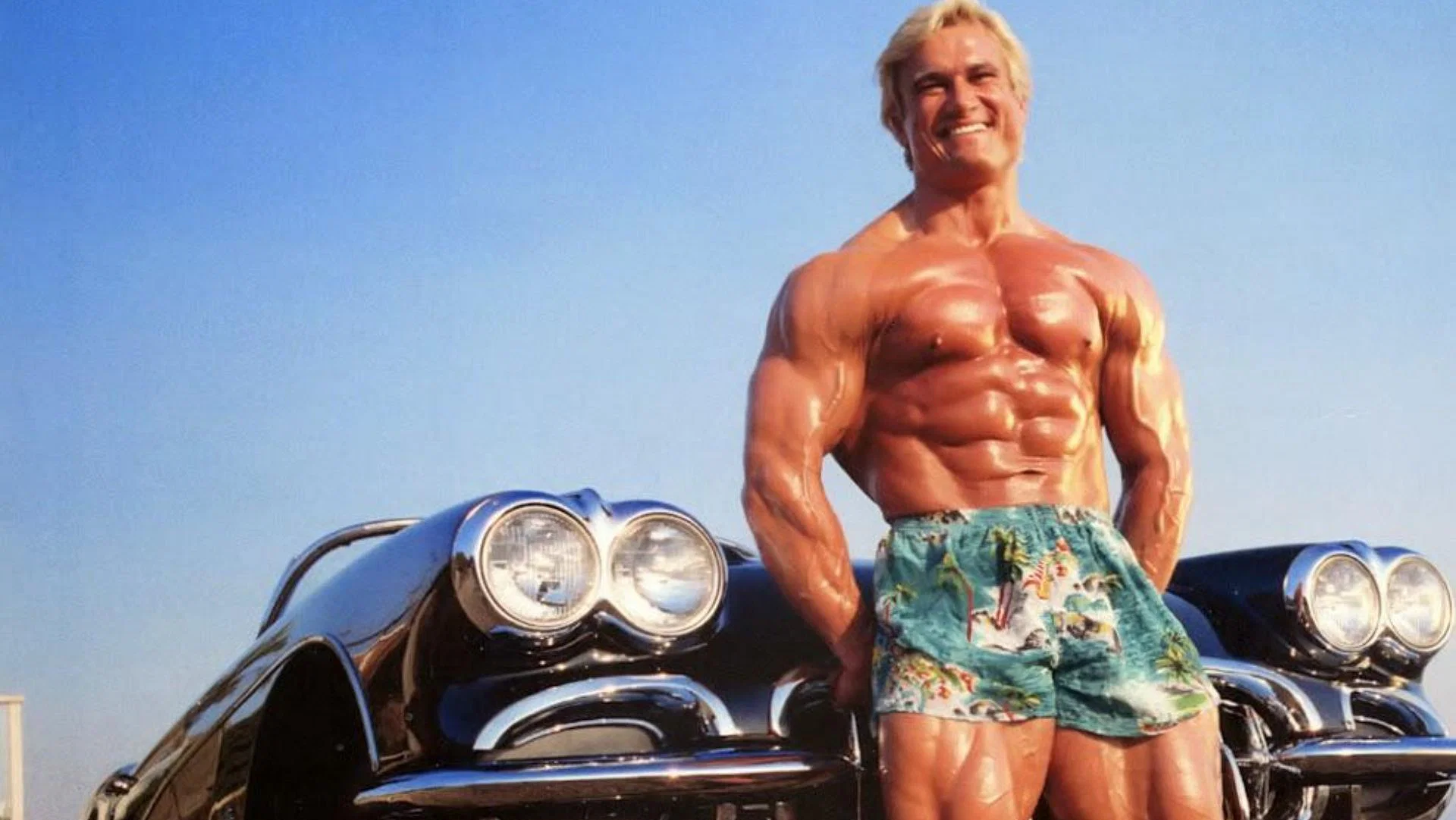
“I really believe attitude monitors talent. You have to take what you want. There has to be a certain amount of killer instinct present. You can’t take no-grow for an answer. This strategy can be applied in any venture.” “Some people like to live without too much risk. They’re satisfied leading a safe existence. This attitude of caution infiltrates into their goals. Every successful athlete – or businessperson – enjoys taking calculated risks. You have to. Especially in the gym when you’re squatting 500 for reps and you can’t get one more but grunt out ten. Your nose starts bleeding, you fall into the rack and that’s set one.
“After being taught sets and reps and working at it for a length of time you can’t paint by numbers anymore. It must come from within. Any artist has an emotional contact with their work. A true bodybuilder doesn’t just build muscle he creates muscle. You can’t be a robot.”
“The first thought that comes to mind when the sets become tough is that I cannot lose. I refuse to lose and be a failure. It’s much more desirable to leave the gym saying, “I won!”

“It’s not a competition between you and someone else. You may not do your best and still win. But when you are competing with yourself you have to beat your own record. When I was in my twenties I didn’t think about it much, but when I was in my mid-thirties I came to realize my own mortality. Let me explain. In my twenties, after doing more reps than I had planned on a set of squats, I’d fall to the floor and cover my eyes. The light hurt them and it felt like there was someone stabbing knives into my legs. There was always severe oxygen debt, but I was confident I’d “come back”. In my thirties I’d lie on the floor sometimes and think, “God damn! What if I don’t come back?”
“Looking back, I do believe my drive to achieve this over-the-top intensity was, in a way, self-abusive. I wasn’t out to kill myself. But when you’re training that hard there is a certain amount of self-abuse. Normal people don’t have to go through that. You don’t drive a normal car excessively hard. A funny car, however, is pushed for all its worth to achieve every last bit of performance. But we learn a lot about our everyday cars from the drag strip. In the same way, we gain knowledge about the human body from pro athletes. Not everyone is psychologically able to be a pro athlete.”
“I wasn’t the biggest bodybuilder. There’s no denying that I had some freaky body parts. But ultimately I think it was most important to me to relay the energy I found in the gym to those in the audience. Through my posing I wanted to change or add to the way people think about the gym experience.”
“Arnold used to enjoy my intensity. He’d comment on the amount of energy I’d conjure up. But I played off the other people, too”

“When you promise yourself something, make a commitment, you can’t give up. Because, when you’re in the gym, you have to fulfill the promise you made to yourself. The people who can self motivate – in any field – are usually the ones who win. Regardless of talent.”
“I used to like putting a little space between plates on the bar. They’d jingle when I came up out of a squat, making a deep-throated roar. The old 45s were the best. The sound would pass through my spine and ears. It was like a car engine revving up. It would help me time my movement. A cue to go down for the next rep.”
“Six-hundred pounds (on squats) became a moderate-rep weight. One month before the ’84 Olympia I did 635 for 12 reps.”
“In 1993, I was just playing around with heavy weights. What we’d (him and Fred Hatfield) do is put over a grand on the bar, take it off the rack and just hold it for a count of ten or twenty. It’s a great idea, but my spine couldn’t handle it.”
“In the process of training I’d find the exact moment of maximum tension within the muscle group and exploit it. I did what I did instinctually, and now scientific data backs it as a viable way to make muscle hypertrophy.”
“I was built to squat.”
“I don’t believe in luck. Luck comes to men of action.”
“The only aspect of my (bodybuilding) career I would change if I could would be to have calmed down a little in the off-season. I was just so enthusiastic.”
“Sometimes your strongest attribute becomes an obstacle. The fact that you can focus and concentrate and nail something usually means you become very good at doing one thing at a time. The problem I’ve encountered is that I sometimes focus so much on one thing that I will forget everything else.”
“The psychological tools I’ve gained from bodybuilding will never atrophy.”
TOM PLATZ’S PRO CONTEST HISTORY

- 1979 Mr. Olympia: 8th
(under 200 pounds) - 1980 Grand Prix: Lafayette, Louisiana 9th
- 1980 Grand Prix: Pittsburgh 10th
- 1980 Night Of Champions: 14th
- 1980 Mr. Olympia: 9th
- 1980 Pro Mr. Universe: 2nd
- 1981 Mr. Olympia: 3rd
- 1982 Mr. Olympia: 6th
- 1984 Mr. Olympia: 10th
- 1985 Mr. Olympia: 7th
- 1986 Mr. Olympia: 11th
- 1987 Grand Prix: Detroit 6th