
You can always tell the members of the Westside Barbell power lifting team by the T-shirts with the Westside Barbell logo and the thickness of their physiques. They share more than just a name across their chest; they also share the recognition of being among the best, meet after meet and year after year. Westside Barbell has produced twenty-three 800-pound squatters, six 900-pound squatters, thirty-six 500-pound benchers, eight 600-pound benchers, four 800-pound dead lifters and 47 Elite totals. An Elite in the sport of power lifting is the highest achievable level, the gold standard of excellence.
What is it that makes this group achieve standards others only dream of? What makes them known as The Best of the Best? This was the question I often asked myself before joining this elite group. I wanted to know what the magic bullet was. What were their secrets behind the numbers? What are they doing different? As I discovered, it has to do with a program that specializes in making a weak athlete strong, and a strong athlete stronger. The training behind Westside Barbell ranges from increasing work capacity to increasing the level of preparedness. The methods responsible for this are the max effort and dynamic effort methods structured under a conjugated method of periodization. These principles are responsible for creating a group of lifters who are confident, motivated, and inspired strength athletes.
At Westside, these attributes are developed year-round and have become known in power lifting circles as the Westside Methods. Today strength athletes can no longer rely on natural ability and strength derived from training using the progressive overload, Western method of periodization, or bodybuilding methods. Today ½s strength athletes have to develop not only strength, but also explosive speed to progress to the next level. Strength is no longer enough.
How did this all get started? Louis Simmons, the owner of the current Westside Barbell Club, chose the name in honor of the original Westside Barbell Club located in Culver City, California. This club was known for great athletes who include Bill “Peanuts” West, George Frenn, Pat Casey, and superstar Billy Graham. In Louie opinion, this club was 30 years ahead of its time. This group of lifters was performing the box squat and bench squats long before Louie had ever considered the idea. It was from an article authored by Bill West and George Frenn that first introduced Louie to the idea. They would use the bench squat for what we refer to at Westside Barbell Club as a high box squat. The height of this bench was approximately 17 inches. They would also squat down to a 10 inch milk crate and this was called the low box squat. Louie has modified these two ideas and has come up with the parallel box squat, which has become a staple exercise at Westside Barbell.

Keep in mind; because change is one of the key components to success in the world of strength training, Louie did not always train under the methods used today. He used to train with the progressive overload approach that many still use.
In 1973 Louie suffered his first serious injury. He had totaled 1655 in the 181-pound class and felt like he was on top of the world. While performing a set of bent-over good mornings, he displaced his L-5 vertebra. Over the next 10 months, he received cortisone shots and walked with crutches. Severe pain prevented him from straightening out his legs completely. The doctor suggested traction for three weeks, however, Louie chose to see a chiropractor instead. After a few visits, he began to retain most of his back strength, but lost a great deal of flexibility in the back and hip region.
In 1978 he posted the fifth highest total in the country with a 710 deadlift. Once again, he was on top of the world, until the 1979 senior nationals when he tore his bicep. Two out of three doctors recommended surgery, but Louie opted to listen to the third. Six months after this injury, he won the Y nationals with a 1950 total, 50 pounds more than he had ever done. During the meet he pulled a 705 dead lift, which was 28 pounds more than he did prior to the torn bicep. During the course of the Y nationals, Louie received two tears in his lower abdominal region. This injury forced him to take six months off training.
Once he began to compete again, he succeeded in squatting 775 and deadlifting 722 in the 220-pound class. Once again in 1983, the lower back pain returned. He had decided to train through it and found himself unable to clear 500 pounds from the floor. This sent him back to the orthopedic surgeon who examined him and found a fractured L-5 vertebra, two compressed discs, and a bone spur! The doctor wanted to remove the two discs and the bone spur, but would offer no guarantee of reducing the pain or regaining flexibility. Louie decided against surgery and took 17 weeks off training. Amazingly, after five training sessions, he decided to enter a meet just to see where he was. He was able to lift a 683 squat and a 551 deadlift due to the lack of flexibility and strength in his lower back.
For most athletes, injuries are an excuse. However for Louie, it was a motivation. The injuries led him to look for better ways to train. His motivation, combined with his research into Russian strength training methods, brought him to the evolving system that is known today as the “Westside Method.” Louie Simmons is a member of and oversees the most sophisticated strength performance team in the country.
So what are these training principles and methods that have propelled Westside Barbell into powerlifting greatness? The periodization scheme used at Westside is known as conjugated periodization. This simply means that there are several abilities being coupled together during the same cycles. These methods are the max effort method and dynamic effort method. There are two days per week scheduled for both methods. Two days per week for the bench, and two days for the squat. The training week is listed below:
- Monday: Max Effort Squat
- Wednesday: Max Effort Bench
- Friday: Dynamic Effort Squat
- Sunday: Dynamic Effort Bench
Mondays are devoted to maximal strength development of the squat and deadlift. This is accomplished through the use of the maximal effort method. This can be simply defined as picking an exercise related to the squat and deadlift and working up to a one-rep max. This method of training is one of the best ways of developing strength, but has its limitations. One of these limitations is that you can�t train above 90% for more than three weeks at a time, or your body will begin to shut down because of the high demands being placed on it. Since the maximal effort method involves working up to one-rep, your training capacity is up to 100%. We avoid the high demands and potential for overtraining by switching the max effort exercise every 1 to 3 weeks. It is also important to warm up using small increases of weight when working up to your one-rep max. For those who squat above 500 pounds, use an average of 50 pound jumps, and for those under 500 pounds, use an average of 20 � 30 pound increases.
The exercises of choice for Westside are Good Mornings, Box Squats, and Deadlifts.

Box Squat: The benefits of this exercise are numerous. It develops eccentric and concentric power by breaking the eccentric-concentric chain. Box squats are a form of overload and isolation. The box squat is the best way to teach proper form of the squat because it is easy to sit way back while pushing your knees out. To take the bar out of the rack, the hands must be evenly placed on the bar.
Secure the bar on the back where it feels the most comfortable. To lift the bar out of the rack, one must push evenly with the legs, arch the back, push your abs out against the belt, and lift the chest up while driving the head back. A high chest will ensure the bar rests as far back as possible. Slide one-foot back then the other, to assume a position to squat. Set your feet up in a wide-stance position. Point your toes straight ahead or slightly outward. Also keep your elbows pulled under the bar. When ready for the decent, make sure to keep the same arched back position.
Pull your shoulders together and push your abs out. To begin the decent, push your hips back first. As you sit back, push your knees out to the sides to ensure maximum hip involvement. Once you reach the box, you need to sit on the box and release the hip flexors. Keep the back arched and abs pushed out while driving your knees out to the side. To begin the ascent, push out on the belt, arch the back as much as possible, and drive the head, chest, and shoulders to the rear. Keep in mind, if you push with the legs first, your buttocks will raise first, forcing the bar over the knees, as in a good morning, causing stress to the lower back and knees and diminishing the power of the squat.
Good Morning: This is one of the most popular max effort squat exercises at Westside Barbell Club. This exercise is performed in one way or another on 70% of all max effort workouts. This is because it works the posterior chain like no other exercise. Done properly, this exercise will work everything between your traps to your calves. Begin this exercise by un-racking a barbell the same as you would a squat. Set up with your feet slightly wider than shoulder-width. Get into a tight position (arched back, shoulder blades pulled together, knees slightly bent, abdominal pushed out against your belt). This is the starting position. Slowly bend forward at the waist until your torso is slightly above parallel with the floor, then reverse the movement to return to the starting position.
Conventional Deadlifts: This max effort exercise is designed to test overall body strength. It is normally advised to use a close grip, hands touching the smooth part of the bar. You will be pulling the bar a shorter distance, by rolling the shoulders forward as you rotate the scapula. This works fine for smaller lifters, but thick large men will do better by using a wider than shoulder grip. This allows room for the stomach to descend between the thighs, which are naturally set wider because of their girth. Most small men should keep their feet close together to use mostly back muscles to lift with, whereas big men use a lot of leg drive to start the lift. Pull the bar up to a standing position.

Sumo Style Dead Lift: Use a moderate stance and a close hand grip. To start the lift, you will rock into the bar, and the hips come up fast toward the bar. This requires a strong back because the legs lock out long before the bar is completely locked. The most common style is with the feet very wide, out to the plates. The lifter should not lower the hips any more than necessary. The back must be arched to the extreme. Most important is to push your feet out to the sides, not down. Why? By pushing down with a sumo or wide stance, your knees will come together, which is the most common mistake in the sumo. By pushing the knees out forcefully, the hips will come toward the bar fast making for a favorable leverage, placing most of the work on the hips, legs, and glutes. TIP: Don’t stay down too long. It will destroy the stretch reflex.
There are hundreds of variations of each movement that can be chosen, with the most important group being the good morning-type movement, which are used on 70 percent of all max effort Mondays.
Monday’s second movement is for the hamstrings. This is usually a very weak and under developed muscle in most lifters and is extremely important in the squat and deadlift. Leg curls will not do! You need to work the hamstrings from both origin and insertion at the same time. In other words, work the hamstrings from both ends. The best exercises for this are Glute Ham Raises, Stiff-Leg Deadlifts, and Romanian Deadlifts. The sets and reps for this exercise are left up to the individual. We are all different and what works for one will not always work for another. A great example of this is the development of the glutes and hamstrings of Eastern block weightlifters. According to many, they would not have been able to achieve this level of development with the use of 3 to 5 sets with 8 to 12 repetitions. The interesting thing is they seldom performed more than 3 reps per set! By leaving the sets and reps up to the lifter, the results will be better because more times than not, the lifter knows what works for them.
The third and fourth exercises for Monday’s workouts are for the core. The lower back and abs are probably the most important muscles in powerlifting. Without them there will be very little transfer of power through the body to the bar. The most effective and most popular lower back exercise at Westside is the reverse hyperextension machine. We live and die by reverse hypers! After hyperextensions, we finish up with some abdominal work. The abdominal work consists of heavy leg raises, incline sit ups, Roman Chair sit ups, spread-eagle sit ups and standing crunches with a lat machine. The key to abs is to train them heavy if you are interested in developing maximum strength!
Wednesday’s workout is designed to increase the maximal strength of the bench press. The same max effort is used as on Monday, but the exercises are now geared toward bench pressing. Some of these exercises include:
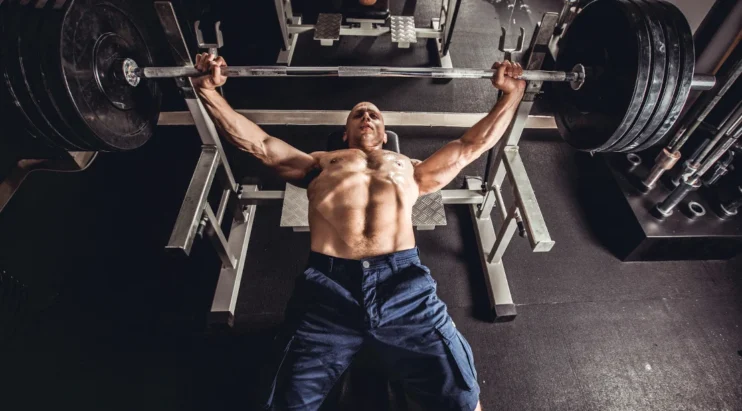
- Bench Press: The bench press should be performed with the shoulder blades pulled together and driven into the bench. The elbows should be in a tucked position. The bar should hit you in the lower chest area. The bar must be pushed in a straight line, not back over the face.
- Board Press: This is a special max effort exercise designed to help strengthen the lockout of the bench press. It is also very effective in increasing triceps strength. This exercise is performed exactly the same as the bench press except you pause the barbell on a board that is placed on your chest. The boards for this workout will be two, 2 by 4 boards about 12 inches in length. Make sure to pause the barbell on the boards before the ascent.
- Close-Grip Board Press: This max effort exercise is performed the same as the board press, except your grip will be closer. It is recommended to place one or two fingers on the smooth part of the bar.
- Close Grip Incline Press: This is a max effort exercise designed to isolate the upper middle regions of the pectoral minor as well as the triceps. To begin this exercise, lay with your back on an incline bench and grasp the bar with one or two fingers on the smooth part of the bar. Un-rack the weight so the arms are fully extended. Lower the barbell with your elbows in a tucked position to the upper chest region. Press the bar back to the starting position.
- Floor Press: This is a special max effort exercise designed to help strengthen the midpoint of the bench press. It is also very effective in increasing triceps strength. This exercise is performed exactly the same as the bench press except you lay on the ground instead of a bench. Make sure to pause in the bottom of the movement before the ascent. This exercise has been used with much success at Westside Barbell Club for the past seven years.
The second exercise on Wednesday’s workout is always for the triceps. The triceps are, without a doubt, the most important muscle for bench pressing. The exercises of choice are laying extensions and presses. Save the pushdowns and overhead extensions for pre/rehabilitation work or the beach. Once again, the sets and reps are up to you.
The third movement is for the lats. Against popular belief, if the bar gets stuck on your chest or right off it by 2 or 3 inches, it is your lats holding you back, not your chest. The primary responsibility of the chest muscles is arm adduction, or pulling you arm across your body. This is why the pec deck and crossovers work so well to isolate the chest. Most all pressing is performed by triceps extension and shoulder rotation. Shoulder rotation is the result or the implementation of the muscles of the upper back, known as the rotator cuff muscles. These muscles together with the lats act to stabilize and move the bar through the proper groove, which happens to be a straight line, not a “J” (pushing back toward the rack), as advocated by many. What is the shortest distance between two points, a straight line or a J? The best exercise for the lats are those that work on a horizontal plane. We all bench on a horizontal plane so the lats should be trained the same way. These exercises include any type of rows such as dumbbell rows, barbell rows, and chest-supported rows. After the lats, finish up with some light shoulder work and get out of the gym!

Friday’s workout is designed to increase the explosive strength of the squat. This is performed with the utilization of the Dynamic Effort Method. The Dynamic Effort method is simply defined as training with sub-maximal weights in an explosive fashion. This style of training will teach the central nervous system to explode through sticking points. Sticking points are also known as “min-maxes” because this is usually the point where failure sets in and the barbell stops. What we try to achieve with this method is to blast trough the sticking point. You can always knock someone back further with a running start. There is more force generated through acceleration. More acceleration equals more force and therefore, no sticking point! The box squat is always trained on this day using 8 sets of 2 reps with a four-week wave starting with 60% and waving up to 70%. This most important aspect of this movement is the barbell speed, not the percent being used. Start with 60 percent and increase over a four-week period. Increase the weight each week as long as you can maintain the same barbell speed you had with 60%.After the Dynamic effort box squats, follow the same guidelines for supplemental work as on Mondays.
The Sunday workout is for the development of explosive and dynamic bench press strength. Use the same dynamic methods described in the Friday workout. The bench press is trained with 8 sets of 3 reps using approximately 50% of your one-rep max. We also use three different grips when training the bench press and all of them are within the rings.
After the Dynamic Effort bench, follow the same guidelines for supplemental work as on Wednesdays.
This is the basic format or template used by Westside Barbell Club. A summary is provided below:
Monday: Max Effort Squat Day Format:
- One Max Effort Exercise: Good Mornings 70%, Low Box Squatting 20%, Deadlifting 10%: Increase weight in small increments for sets of three. When three reps become difficult, drop to singles until a one-rep max is reached.
Supplemental Exercise: Hamstrings: Glute Ham Raises, Stiff Leg Deadlifts, Romanian Deadlifts: Sets and reps are up to the lifter.
Accessory Exercise: Reverse Hypers: Sets and reps up to the lifter.
Accessory Exercise: Abs
Wednesday: Max Effort Bench Day Format:
- One Max Effort Exercise: Floor, Board, Close Grip, Incline Presses: Increase weight in small increments for sets of three. When three reps become difficult, drop to singles until a one-rep max is reached.
- Supplemental Exercise: Triceps: Lying extensions and presses: Sets and reps are up to the lifter.
- Accessory Exercise: Lats: any type of rows.
- Accessory Exercise: Shoulders and extra triceps.
Friday: Dynamic Effort Squat Day Format:
- Box Squats: 8 sets of 2 reps using the Dynamic Effort Method.
- Supplemental Exercise: Hamstrings: Glute Ham Raises, Stiff Leg Deadlifts, Romanian Deadlifts: Sets and reps are up to the lifter.
- Accessory Exercise: Reverse Hypers: Sets and reps up to the lifter.
- Accessory Exercise: Abs
Sunday: Dynamic Effort Bench Day Format:
- Bench Press: 8 sets of 3 reps using the Dynamic Effort Method.
- Supplemental Exercise: Triceps: lying extensions or presses: Sets and reps are up to the lifter.
- Accessory Exercise: Lats: any type of rows.
- Accessory Exercise: Shoulders and extra triceps.
The Conjugated Periodization method, utilizing the maximal effort, and dynamic effort methods have propelled Westside Barbell Club into strength greatness. The special exercises used by Westside have also had a great impact on the progress and success of its lifters. By applying these methods to your training program, you will see dramatic differences in maximal strength levels. I should know because I have been a member for the last 10 years and have seen my lifts go from a 750 squat to a 935, a 500 bench to a 585, and a 680 deadlift to a 740.