

The deadlift is a heavy compound movement that should be included in the exercise program of any lifter. As this lift will strengthen not only the entire back, but the musculature of the hips, abdominals, and legs, as well as work the grip, proficiency in this lift is a must. Like the squat, the deadlift will stimulate a growth response from the body that should carry over into strength and size gains in other areas.
There are two basic styles of deadlifting, conventional and sumo. Each style will be explained, and compared to the contrasting style. While certain aspects of deadlifting are similar, such as the fact that the lifter is basically picking a weight up off of the deck, and raising to the highest possible levels, a great many differences in biomechanics occur as a result of the differing styles.
The conventional stance consists of the athlete standing with the feet approximately shoulder width apart, or slightly narrower. To position the feet properly, slide them forward as far as possible without moving the shoulders in front of the bar. The hips should be as close to the bar as possible as well, but the lower back must remain arched.
The head should be elevated so that the athlete is looking forward and slightly upwards. The shoulders should be back, but slightly rounded. Retracting the shoulders causes the shoulder girdle to elevate, increasing the distance the lifter must pull the bar. The athlete must grip the bar tightly, and to ensure that the bar does not roll, a mixed grip (one hand supinated, one hand pronated) is often employed.

The true beginning of the deadlift is the set up, or the first phase (as it is known in Olympic lifting), which has already been described. The next step, before pulling the bar free from the deck is to fill the abdominal cavity with air. While drawing in as much air as possible, the goal is to push it down as far as possible, not fill the chest cavity. Filling the chest cavity with air elevates the shoulders, which will increase the distance the lifter must pull the bar.
The deadlift is initiated by simultaneously extending the knee and hip joints. The knee will extend due to the contraction of the quadriceps muscles (vastus lateralis, vastus medialis, vastus intermedius, and rectus femoris), and, during the extension, may move slightly to the rear. The hip joint will extend secondary to the contraction of the gluteus and the hamstrings (biceps femoris, semitendinosus, and semimembranosus). While the entire hamstring is active to a certain degree during the deadlift, the semitendinosus and semimembranosus are recruited to a much greater degree to extend the hip joint.
The bar should be pulled into the body, as well as up. This keeps the athlete from falling forward during the lift, as it helps maintain a far more stable combined center of gravity (CCOG). This is where the placement of the feet is a significant factor. If they are too far forward, causing the shins to be closer to the bar than necessary, the bar must be pulled around the knees, instead of past them. This shortens the lever arm distance and reduces the resistive torque.
During this period, and indeed, throughout the entire lift, the musculature of the upper back and shoulders (trapezius, latissimus dorsai, teres minor, subscapularis, infraspinatus, supraspinatus, as well as the anterior, medial and posterior deltoids) will be undergoing an isometric contraction to hold the bar in a stable position. In the arm, the biceps brachii, brachialis, and brachioradialis will also contract isometrically to stabilize the elbow joint. The forearm flexors are extremely active during the gripping of the bar.
The erector spinae
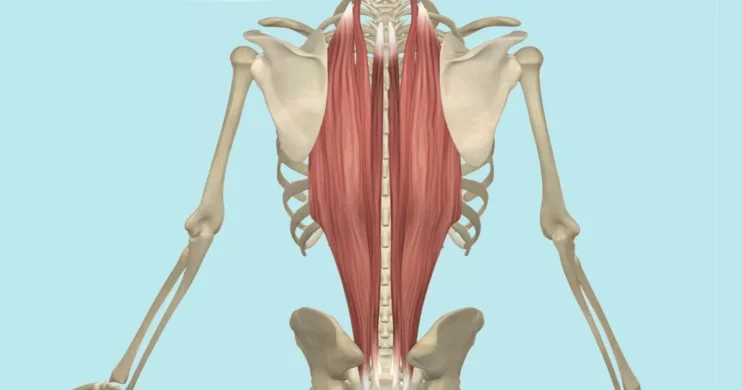
(iliocostalis thoracis, iliocostalis lumborum, longissimus dorsai, and spinalis dorsai) will contract during the lift, along with the intertransversarii, interspinalis, rotores, and multifidus muscles to bring the spine into an erect position. These muscles become more active once the back is extended past a point that would be 60 degrees away from vertical. The inter-transversarii, interspinalis, rotors, and multifidus will also serve to stabilize the vertebrae and discs. In the conventional deadlift, the torso is inclined far more than in the sumo style, in direct contrast to recommendations for a more erect torso to reduce shear force on the lumbar vertebrae.4,9,12
As the bar travels past the knees, and up the thighs, several key points must be noted. It is imperative that the knees not re-bend once they have begun to straighten. In addition to the extra strain this will put on the ligaments and tendons, secondary flexion of the knees (hitching) is cause for disqualification during a competition. Another mistake that is often made as the lift nears completion is the lifter will try to pull the torso back, when it is far easier to simply push the hips forward.
This technique will allow the athlete to shift some of the strain from the erectors to the larger muscles of the hips, including the gluteus. At the top of the lift, the shoulders should be pulled back to indicate the completion of the lift. This is not necessary for routine training of the deadlift, but a powerlifter should practice this to avoid unnecessary red lights.
The major

Difference that occurs in the sumo deadlift is the placement of the feet. They are placed much wider, sometimes even twice shoulder width, although this is an extreme. The toes are turned outward, sometimes to the point where the angle of the feet approaches 160 degrees. There are several biomechanical advantages to this stance.
The distance
The bar must travel is greatly lessened as the hip angle is on average 12 degrees greater than the hip angles of conventional deadlifters, while the knee angle is approximately 13 degrees greater.7,12 The trunk angle is significantly closer to vertical, which, from a pure safety standpoint, the sumo stance decreases both L4/L5 moments as well as shear forces. 4Furthermore, the sumo stance allows the lifter to keep the bar closer to the body, which shortens the movement arm to the lumbar spine.12 This stance can reduce the total distance the bar travels by as much as 25 40%.7
The functional technique
In the deadlift is different as well. The athlete pulling a conventional deadlift will push straight down with the feet, whereas in the sumo deadlift, the knees must be pushed out over the toes. This is important, to avoid lateral shear force on the knee, as well as the fact that it allows the lifter to engage the larger muscles of the hips earlier than in the conventional stance.
As a function of the bar being closer to the lifter, it will contact the legs earlier. As the bar slides up the thighs, it is important to ensure that the fingers of the pronated hand are not torn open by the friction thus generated. A modest amount of baby powder or talcum may be applied to the legs to reduce the chance of this occurring.
One factor that has not been discussed that makes the deadlift unique among the three powerlifts is that unlike the squat and bench, there is no eccentric (lengthening, or lowering) portion prior to the concentric (shortening, or raising) of the bar. This has the function of negating the stretch reflex, a fact that is often overlooked by many athletes and coaches alike.
There is a way of generating a small stretch reflex, which may help when initiating the lift, but nothing like the reflex that can be generated during the other two powerlifts. In the conventional stance, a slight rocking of the hips, which will cause the knees to flex as well, can be employed. The lift should be initiated when the hips are at the lowest point, and this movement must occur rapidly. Care must be taken when doing this, as if the hips descend too far, the lifter will be at a biomechanical disadvantage.
Unsurprisingly, there is a difference when using this technique when pulling sumo. This technique (often called ‘diving’) can allow the sumo lifter to generate a greater stretch reflex without moving out of position, unlike the conventional deadlift. Because the feet are father apart, instead of just raising and lowering the hips, the hips should be lowered rapidly then thrust forward at the bottom of the descent. This allows not only for a greater stretch reflex, but for an even more erect torso than lifters who pull from a static position.
Variations on the Deadlift

There are several varieties of the deadlift, and can be used not only to assist in deadlift training, but can also significantly strengthen muscles that can be impeding progress in another lift. Some of these lifts can be used in place of the deadlift during training as well.
One of the most common variations of the deadlift is the partial deadlift, or rack lockout. These are usually performed in a power rack, with the pins set at a variety of heights. Pulls can be done from one inch above the deck to a couple of inches below lockout. As a general rule, the shorter the ROM, the more weight that can be handled.
The primary function of the partial deadlift is to not only overload the muscles of the back, as well as increase motor recruitment.5,18 At times, the amount of weight that can be handled during the execution of a short range of motion rack pull can be so great that it surpasses the amount of weight the athlete can hold. In this case, it may be necessary to employ straps to secure the weight.6
Another common variation is the stiff-legged deadlift (SLDL) which will work the hamstrings to a much greater degree than the conventional deadlift.2,10 This lift should begin just like a conventional deadlift, and should be pulled to the top in the same manner. The knees will be stiff, but not locked, as the bar is lowered as far as possible without allowing the back to round.
The lower back should remain arched throughout the entire lift, and if the back begins to round despite the best attempts of the athlete, it is necessary at this point to begin the concentric portion of the lift and raise the bar. The bar will travel away from the lifter as the hips are flexed progressively. There is greater torque on the hips and lumbar areas because of the greater horizontal distance from the bar to the base of the support than in the conventional deadlift.3,4,17
Despite the fact that numerous “muscle mags” often illustrate a lifter performing this exercise while elevated, this should be avoided by all at first and most athletes for the duration of their career. The greater the range of motion, the greater the chance of lifting with a kyphotic (round
back) posture.10 Artificially increasing the ROM will serve only to increase the chances of this occurring. It must also be noted that a comprehensive stretching program is essential to not only athletes, but everyone wishing to improve the ROM of this exercise.
The Romanian Deadlift (RDL)

Is used primarily to strengthen the hamstrings, gluteus, and lower back, although this technique causes less stress to the lumbar area. Unlike the SLDL, the RDL is initiated from the floor, although the set up is roughly in-between that of the conventional deadlift and the SLDL.23 During the ascension, the knees should begin to straighten in advance of the hips, with the goal of keep the torso at the same angle as in the beginning of the lift for as long as possible.
This should occur while maintaining normal spinal curvature. Pulling in such a manner allows the athlete to keep the bar closer to the base of support, decreasing the strain on the lumbar area when compared to the SLDL. As the knees fully straighten, the hips shall travel toward the rear slightly, then the hips are then powerfully flexed, fully utilizing the hamstrings and erectors to complete the lift. This lift is often performed by Olympic style weightlifters to increase the strength of the clean pull.
Another variation that is not often performed is the Snatch Grip Deadlift (SGL). This version of the deadlift is similar to a conventional deadlift, with the only difference occurring in the placement of the hands upon the bar. The grip is at least one and a half times shoulder width, while larger lifters will often grip collar to collar. A good general guide to novices is to extended the arms out to the sides, then bend only at the elbow. The bar should be held at approximately the width of the elbows.
The difficulty of maintaining the grip in such a position, as the mixed grip cannot be used, will require the used of straps for those not very experienced in utilizing the hook grip. This lift will further stress the musculature of the upper back, particularly the trapezius.19 This lift is often performed by Olympic style weightlifters to increase power of the first pull, making it easier for the athlete to raise weights from the deck.
A simple method of increasing the ROM of a deadlift is for the athlete to stand on a block. Once again, care must be taken to avoid kyphotic lifting posture. The increase in ROM will necessitate a decrease in weight.
Deadlift Training
There are far too many methods of training to improve the deadlift to list here. A few will be briefly discussed. Periodization. This is a simple yet effective method of decreasing the volume while increasing the weight. This process occurs over a period of weeks or months. It is by far the most common method of training, although lifters are branching out in new directions daily. This method has been discussed in great detail in numerous other works, and will not be discussed further here.
Conjugate Training
This is a system of training the musculature of the lift without overtraining the CNS with respect to a single lift. The deadlift is not trained heavy throughout the cycle, and in some training cycles, may be trained only rarely. This method was first used in Olympic weightlifting by the incredibly successful Soviet Dynamo Club.24
It was later used by the original Westside Barbell Club in the 1960’s and 1970’s, as well as some lifters on the East coast, including Bill Starr, a former Olympic weightlifter turned coach.21It is currently the system employed by the new Westside Barbell Club, of Columbus, Ohio, under the coaching of Louie Simmons, the most successful coach in powerlifting history.20 This method will involve heavy assistance work for the lift itself, such as partial deadlifts, good mornings, etc. A list of assistance exercises can be found at: www.elitefts.com
An interesting variation for training the deadlift was employed by the great Don Rheinholdt, the first man to squat 900 lbs. in competition as well as being one of the first to deadlift over 800 lbs. He would set up with his opener in the power rack eight inches off of the deck, and pull it. He would then drop the pins one inch every week until the week before the meet, when the plates were just a single inch off of the floor. This allowed him to preserve his lower back while maintaining proper form.
A final word on a couple of myths
Numerous “experts” have cautioned against utilizing the deadlift, incorrectly stating that it is hazardous to perform. This is true, if the above cautions are not employed. While there can be a place for round back lifting in the program of the highly advanced lifter, this is a mistake for most and will not be discussed further. Other self proclaimed authorities state that you must wear a belt when deadlifting. A belt can help increase intra-abdominal pressure, as well as increase the force generated when deadlifting. However, the majority of the deadlifting done by any athlete should be performed without a belt to further recruit the core muscles (abdominals, obliques, etc.).
References
-
- Bacchle, T.R. Essentials of Strength Training and Conditioning. Champaign IL: Human Kinetics, 1994.
- Baker, G. Exercise of the month. Strength Cond. J. 16:54-55.1994.
- Brown, E.W., and Abani, K. Kinematics and kinetics of the deadlift in adolescent powerlifters. Med. Sci. Sports Exerc. 17:554-563. 1985.
- Cholewicki, J., McGill, S.M., and R.W. Norman. Lumbar spine loads during the lifting of extremely heavy weights. Med. Sci. Sports Exerc. 23:1179-1186. 1986.
- Daniels, D. Partial lifts, partial results. Powerlifting USA. 17:27 1993.
- Daniels, D. Lifting straps. Powerlifting USA. 19:17 1996.
- Escamilla, R.F. et al. A three-dimensional biomechanical analysis of sumo and conventional style deadlifts. Med. Sci. Sports Exerc., 32(7): 1265-1275. 2000.
- Enoka, R.M. Neuromechanical Basis of Kinesiology. Champaign, IL: Human Kinetics, 988.
- Farley, K. Analysis of the conventional deadlift. Strength Cond. J. 17:55-57. 1995.
- Gardner, P.J. and Cole, D. The stiff-legged deadlift. Strength Cond. J. 21:7-14. 1999.
- Garhammer, J. Weightlifting and training. In: Biomechanics of Sport. C.L. Vaughan, ed. Boca Raton, FL: CRC Press, 1989. pp 169-211.
- Grabiner, M.D. and Garhammer, J. Analysis and assessment of human movement performance. In: Kinesiology and Applied Anatomy. P.J. Rasch, ed. Philadelphia: Lea & Febiger, 1989. pp 247-258.
- Horn, T.S. A biomechanical comparison of sumo and conventional deadlifting techniques. Int. J. Sports Med. 9:150. 1988.
- Jones, L. USWF Club Coach Accreditation Course: Club Coach Manual. Colorado Springs, CO: U.S. Weightlifting Federation. 1991
- Kraemer, W.J. and Fleck, S.J. Strength Training for Young Athletes. Champaign, IL: Human Kinetics. 1993.
- McLaughin, T.M., Dillman, C.J., and Lardner, T.J. A Kinematic model of performance in the parallel squat by champion powerlifters. Med. Sci. Sports Exerc. 9:128-133. 1977.
- McGuigan, M.R.M., and B.D. Wilson. Biomechanical analysis of the deadlift. J. Strength Cond. Res. 10:250-255. 1996.
- Piper, T.J. and Waller, M. Variations of the deadlift. Strength Cond. J. 23: (3) 66-73).
- Rasch, P.J. Weight Training (2nd ed.). Dubuque, IA: Wm. C. Brown Company Publishers. 1975.
- Simmons, L. So you want to deadlift. Powerlifting USA. 17:34-35. 1994.
- Starr, B. Deadlift without deadlifting. Powerlifting USA. 18:10-11. 1995.
- Tate, D. Top Ten deadlifting mistakes.
- Whaley, O., and McClure, R. Another perspective on teaching the pulling movements. Strength Cond. J. 19:58-61. 1997.
- Zatsiorsky, V.M. Science and Practice of Strength Training. Champaign IL. Human Kinetics. 1995.
- Zinc, A. J., Whiting, W.C., Vincent, W.J., and McLaine, A.J. The effects of a weight belt on trunk and leg muscle activity and joint kinematics during the squat exercise. J. Strength Cond. Res. 15(2):235-240. 1994.