
Very rarely do you ever see people deadlifting. Those that do are usually powerlifters or someone who is actually performing a variation of a deadlift. Often missing, the deadlift is an integral component of a strength building program. That’s not to say that everyone should be performing this movement or one of its variations, but the benefits of the deadlift for a power or strength building program are innumerable.
Though it is one of the three lifts in powerlifting competition, it is not given the respect that the squat and bench press are. You never hear people bragging about how much they can pull. In fact, the deadlift may be a better measure of total body strength than the other two lifts by nature of the sheer number of muscles that are needed to perform the deadlift. The deadlift is a compound exercise targeting several muscle groups in the lower and upper body including the latissimus dorsi, trapezius, erector spinae, gluteals, hamstrings, quadriceps, and psoas (hip flexors). Your forearm muscles, which are involved in gripping the bar, are strongly involved, as are muscles involved in trunk stabilization such as your obliques and abdominals. In all, nearly three quarters of your total muscle mass is involved in performing this compound movement.

The deadlift also has many benefits. As a compound exercise, the movement involves action at almost all of your body is joints, including ankles, knees, hips, the vertebrae, shoulders and fingers.2 When compared to isolation exercises, compound movements that involve larger muscle groups elicit a hormonal training response that result in greater strength gains.1 The dynamics of the lift itself may also lead to greater gains in hypertrophy.1 In laymen¹s terms, you will get stronger and bigger muscles!
The deadlift also has possible rehabilitation benefits. It has been hypothesized that the moderate to high hamstring activity elicited during the deadlift may help to protect the Anterior Cruciate Ligament during rehab.2 The movement of the deadlift translates well into real life as it mimics bending and lifting. Anyone who has a toddler is quite familiar with the motion of the lift already.
There are two basic styles of deadlifting; sumo and conventional. The key difference between the two styles is the placement of the feet and the width of the grip. In the sumo style, you assume a very wide stance and your arms hang down between your legs as you grip the bar. In the conventional style, your stance is relatively narrow, and your arms hang outside your legs as you grip the bar.
The sumo style has gained a reputation as decreasing the stress placed on the lumbar vertebrae by as much as 10% when compared to the conventional deadlift.2 It also seems to be favored among those who are leaner and have longer than average torsos. Since the sumo style requires less hip flexion and a more upright trunk position in the starting position of the lift, this may benefit lifters with a relatively longer torso by reducing the shear forces on the lumbar vertebrae. We also know that the sumo style deadlift requires much larger knee and ankle moments- these joints are at a more acute angle at the start of the lift then when compared to the conventional style.2 This implies that the quadriceps may be more active in the sumo style than in the conventional style. Because of the wide stance utilized in the sumo style, this method requires less mechanical work than the conventional.2 The bar actually moves less distance.
In comparison, a conventional grip will place less stress on the knee and ankle joints and more stress on the lower lumbar. The increased angle of hip flexion at the start of the lift will also require hamstring and gluteal movement to overcome the angle. Though you may have to move the bar farther, the amount of distance would not really be that much greater for a shorter person. Furthermore, the combined strength of your gluteals and hamstrings may allow you to lift more weight than if the majority of force output was from your quadriceps. It is important to note that world records in powerlifting have been established using both styles.
Performing the Lifts
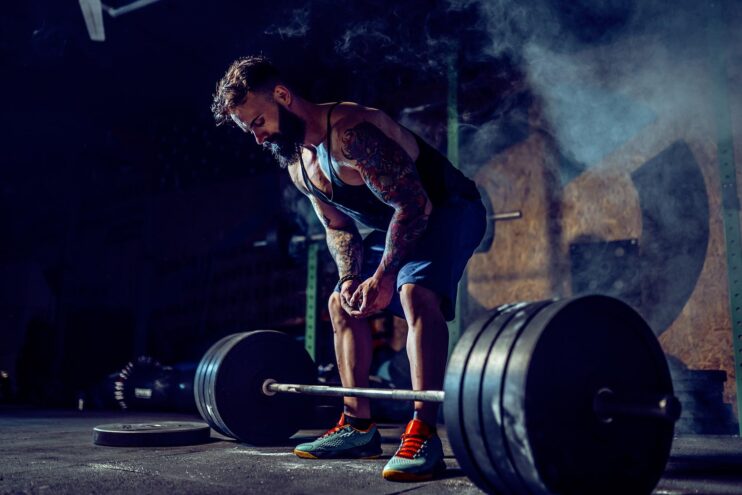
Beginning position
- Feet should be flat on the floor about shoulder width apart in the conventional style and slightly farther apart in the sumo style.
- Grip bar with a closed, alternate grip (one palm facing you the other away from you).
- Knees should be flexed as in a full squat position.
- Bar should be as close to the shins as possible.
- Back should be flat.
- Head should be up or in a neutral position.
Upward movement
- Begin pull by extending at the hips and knees, such that the hips and shoulders move at the same rate, keeping the back flat, with the shoulders above or slightly in front of bar.
- As the bar passes your knees, thrust hips forwards and your shoulders back.
- The hips and knees should be fully extended, and your shoulders back (as opposed to rounded forward).
Downward Movement
- In the downward phase, release the tension in your muscles so that gravity alone allows the bar to descend to the floor.
- Rules in powerlifting competition require that you maintain a grip on the bar so as to control its descent.
- Do not attempt to lower the bar at an extremely slow rate, as the eccentric stress is taxing and causes undue micro trauma and vertebral stress.
- The lift ends when the bar is motionless on the floor in front of you.
Points to Remember
- Your back should be flat throughout the movement.
- At no portion of the lift should your back or shoulders be rounded o keep the bar as close to the shins as possible during the initial pull, and as close to your thighs as possible after the bar passes your knees.
- Feet should always be flat on the floor, with your center of gravity over the back half of your feet.
- Exhale through the sticking point of the pull (some lifters find it advantageous to exhale forcefully as in screaming).
- Do not jerk the bar off the floor. The pull should be a smooth, max effort from the beginning.
- Pay attention to good form. If your technique begins to break down from the sheer weight on the bar, you predispose yourself to injury. Rounding of your back, knees buckling inward and initiating the pull with your back instead of legs and hips are examples of common technique errors that are potentially damaging.
- Because of the many muscles involved in the lift, you may require more rest between sets than normal.
The deadlift itself has many variations. You can use barbells for lighter weights or use a limited range of motion if the situation calls for it. For instance, I recently had an ankle injury that limited my range of motion in that joint. Instead of doing reps from the floor, I only lowered the bar halfway. There are also specialized bars that some people find more comfortable such as the Combo Bar, “U” bar or Trap Bar.
Keystone deadlifts are a great exercise that can help you increase your deadlift totals. They are done in a power rack and the weight is only lifted from your knees. There is an exaggerated pelvic tilt such that you go into mild hyper flexion of the lumbar spine. This forward pelvic tilt pre-stretches the hamstring and allowing you to overload them more effectively.
Stiff-legged deadlifts, also called Romanian deadlifts, target your hamstrings and erector muscles (the muscles in your lower back). To perform this exercise, place your feet about 8 inches apart and place your hands on the barbell shoulder width apart. Keeping your legs and back straight, lower the bar to mid-shin level and bring the bar back up. Though your legs are straight, your knees should not be locked. The positioning of your body and movement plane of the bar is similar to a deadlift.
As in all exercises, the deadlift is not for everyone. If you have lower lumbar injuries or any other joint injuries, it is important to get your doctor’s or chiropractor’s release before adding this lift to your regime.
Because of the wide range of muscles the deadlift targets, some people use it as a warm-up lift before their workout. In whatever form you use, the deadlift should play an important role in your training program.
A short bio on me:
I hold my Bachelor’s degree in Exercise Science form the Pennsylvania State University and am currently completing my Master’s degree in Health Psychology. I also work for the International
Bibliography:
- Baechle, T. Essentials of Strength and Conditioning. Human Kinetics, Illinois, 1994
- Escamilla, R., et al. A three-dimensional biomechanical analysis of sumo and conventional style deadlifts. Medicine and Science in Sports and Exercise, 2000;32:1265-1275.
- Hatfield, F. Fitness: The Complete Guide. ISSA, Santa Barbara, 2000.